
Benefits of Completing GFI’s Certification

By pastor Josh Ogle

One of the stories in Scripture that has captivated me in recent years has been the account of Jesus raising Lazarus from the dead. The reason is two fold.

First, Jesus had a greater plan than anyone could have imagined. He was going to do something that Mary and Martha never imagined. They had an idea of what Jesus would do, but Jesus was about to help them see that He was much more than they realized. He was leading them to see that He is the resurrection and the life. Not just that He has power to raise the dead (which He does), but that He is the resurrection. That there is life in Him and Him alone.

Second, Jesus indeed raises their brother Lazarus from the dead and at the end of the narrative we hear Him give the direction to “take off the grave clothes and let him go” (John 11:44). This final call of the narrative is easy to dismiss, but part of my GFI training has helped me to see the power in this call. Jesus is the giver of life. We find that life in Jesus alone through our identification with Him. Unfortunately, there are too many Christians who are alive in Christ, but still walk around bound by grave clothes. They have never been told to take them off and walk in freedom. My time in the Grace Fellowship International training has helped me to articulate not just the saving power of Jesus, but the living power of Jesus to loose us from the grave clothes of our flesh. This narrative provides a wonderful example of the life Jesus gives and the means by which we experience this life in our everyday walk.

Jesus is the resurrection and the life. The GFI Training has given a way to articulate and describe the need to find everything in Jesus alone. The Wheel & Line diagrams have been so helpful to leading folks to see that there is life in Jesus. Simply shifting from “doing in order to be” into “being in order to do” is a life changing dynamic for the Christian life. As a seminary trained pastor, I knew that Jesus gives us eternal life. I knew that He saves us from our sin. I knew we needed Him. Those were clear, but I had a nagging question, “Does Jesus really make a difference today?” The training I’ve received has allowed me to confidently answer, “YES HE DOES!” because of our union with Him. I’ve found my teaching and preaching shift from a moral, behavioral management into a surrendered, Spirit-empowered step of faith. The reality of our union with Christ rather than a symbolic, or poetic phrasing has been life changing for me. I spend more time pointing people to the need to “be with Jesus” and receive His love for them.

While there is life in Jesus through our identification with Him, I have been so blessed by knowing that Jesus gives us power over sin as well. Those grave clothes of the flesh are no longer things that hold us back. Because of Jesus, we can recognize them and respond in faith to His truth rather than simply react in our flesh. The training that walked slowly and diligently through Romans 5-8 and Colossians 3 have given me ways to lead people into the freedom that Jesus brings. It has been so good to walk others through the Wheel diagram to help them see themselves clearly. I have seen Holy Spirit open their eyes to the grave clothes that He has called them to put off.

It is a wonderful blessing when this has happened! Prior to this training, I spent so much time teaching people to live in gratitude for their justification in Christ. I talked about sanctification, but only as a means of doing Godly acts out of gratitude for Jesus saving a sinner like me. Through this training, I can biblically articulate for others why we are no longer sinners, but saints. I can point them to see the truth that they can experience victory of their sin one step of faith at a time as they walk by the Spirit instead of working in their flesh (Galatians 5). That has been a great shift for counseling purposes and application in preaching the gospel.

As I look ahead, I want to grow in how to utilize this training for a whole hearted discipleship model. I was particularly impacted by the book A Deeper Walk: A Proven Path for Developing a More Vibrant Faith by Marcus Warner on this topic.[1] He integrates many of the GFI training into a whole person discipleship path using the acronym FISH (Freedom, Identity, Spirit, Heart-focused Community). This was compelling to me and provided a means to easily lead others into this truth in a discipleship setting. I have spent time praying over this and have developed a different acronym based off of Galatians 2:20. I want to use LIVE because it seamlessly fits into the statement, we are called to live by faith in Jesus as believers. LIVE: Love. Identity. Victory. Empowered. My hope is to describe it in this way…

  • Live in the LOVE we have received in Jesus and extend His love to others.
  • Live in the IDENTITY we have been given in Jesus.
  • Live in the VICTORY Jesus has won over our flesh, our enemy, and our sin.
  • Live EMPOWERED by the Holy Spirit.


While I’m still building this out in my mind, I think Galatians 2:20 gives us a good framework for this principle. I’ve found myself using this as a simple daily prayer path and hope to find a way to use this in discipling others to live by faith in Jesus. As I come to the end of this practicum training, I’m excited to continue growing in my ability to utilize the GFI tools and see the Lord use them to lead people to find life in Jesus alone.


[1] See DeeperWalkInternational.org
Previously International Center for Biblical Counseling (ICBC), founded by Mark Bubeck. They have a “phase 3” / freedom in Christ emphasis. – JBW

Josh Ogle currently serves as pastor of Hillcrest Baptist Church in Morristown, Tennessee.

This paper is shared by permission. See the Exchanged Life Counselor certification track here.

Living in Christ Ministries

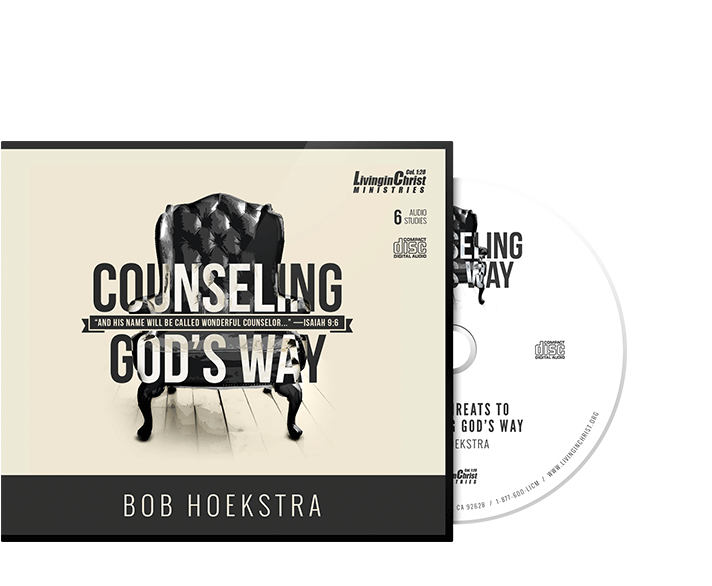
Discipleship Counselors can greatly benefit from the teaching ministry of Bob Hoekstra.

Pastor Bob Hoekstra [1940-2011] was the founder and Director of Living in Christ Ministries. Bob was in ministry since 1967, including pastoring fourteen years in Dallas, TX and eleven years in Irvine, CA… Bob graduated from Dallas Theological Seminary in 1973 with the Master of Theology degree.

Bob’s involvement with the Calvary Chapels began in 1971, when he and his wife Dini visited Calvary Chapel Costa Mesa on a Sunday evening…Upon returning to Dallas, they regularly obtained Pastor Chuck Smith’s teaching tapes and eventually became daily listeners of the Word for Today on the radio.

Bob taught at many church fellowships across the country and overseas (including, Seminars, Pastors’ Conferences, Church Services, Leadership Conferences, Retreats, and Schools of Evangelism/Ministry). He also taught numerous classes at Bible Colleges in California.[1]

Of particular interest to Discipleship Counselors is Bob Hoekstra’s course on Counseling God’s Way. Note how many of the course’s topics correlate with Grace Fellowship’s emphasis:

  1. The Lord as Counselor – Part 1
  2. The Lord as Counselor – Part 2
  3. Counseling and Discipleship
  4. Counseling and Sanctification
    God’s Way in Counseling
  5. God’s Word in Counseling
  6. The Holy Spirit in Counseling
  7. Prayer in Counseling
  8. Church-life in Counseling
    Counselors and Their Equipping
  9. Who is to do Counseling
  10. Equipping for Counseling Ministry
  11. Vital Issues for Counseling – Part 1
  12. Vital Issues for Counseling – Part 2
    Foundational Truths for Counseling
  13. In Adam or in Christ
  14. United with Christ
  15. Walking According to the Flesh
  16. Walking According to the Spirit
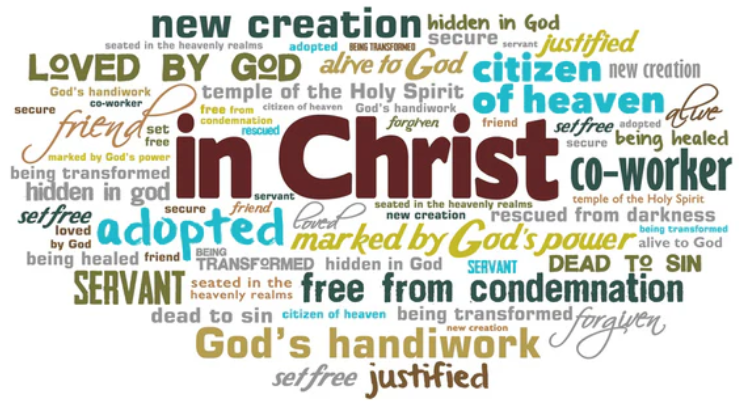
  17. Who We are in Christ
  18. Renewing of the Mind
  19. Spiritual Warfare
  20. Victory in Spiritual Warfare
    Major Threats to Counseling God’s Way
  21. Forsaking Our Wonderful Counselor
  22. Turning to Worldly Counsel
    Counseling Session Guidelines
  23. Counseling Session Guidelines – Part 1
  24. Counseling Session Guidelines – Part 2

The course (text and audio) is online here:
www.blueletterbible.org/audio_video/hoekstra_bob/counseling24/counseling-gods-way.cfm The full outline document is here.

Another valuable resource for personal edification and counselee “homework” is his devotional Day by Day by Grace. Each devotional has substantial biblical content with a grace orientation. The full year of devotionals is online as an index, or by creating an account at BlueLetterBible.org, one can subscribe to it as a daily email.
www.blueletterbible.org/devotionals/dbdbg/view.cfm
It is also available in paperback and ebook formats. livinginchrist.org/devotional/

For personal enrichment and reinforcement in the truths of living in Jesus Christ, check out Bob Hoekstra’s many legacy resources at BlueLetterBible.org and LivingInChrist.org.

JBW


[1] livinginchrist.org/about/

Bob’s memorial website is www.bobhoekstra.com/

Christ Centered Soul Care

Soul care has become an important aspect Christian life and ministry. This concept includes several themes, such as love, spiritual direction, mutual edification, relational support (fellowship) and biblical counseling.

Love is the essence of the Greatest Commandments — to love God supremely and to love one’s neighbor as yourself (Matt. 22:36-40; Deut. 6:5). This should be expressed practically: “Since you have purified your souls in obeying the truth through the Spirit in sincere love of the brethren, love one another fervently with a pure heart” (1 Pet. 1:22). This care involves bearing one another’s burdens (Gal. 6:2). There should be mutual confession and prayer for physical and psychological healing (James 5:16). As we receive comfort in the midst of trials, we should be equipped to be vessels of comfort to others (2 Cor. 1:3-5).

The spiritual direction component has been described as “A person seeking help in cultivating a deeper relationship with God meets with another for prayer and conversation that is focused on increasing awareness of God in the midst of life’s experiences and facilitating surrender to God’s will.” [1]

Spiritual counseling is similar, yet has an orientation of overcoming life’s problems. Christian mental health counseling should be spiritual in source and wisdom but may be more overt in defining mental, emotional, and behavioral symptoms with the a more overt attention to the social causes and psychological dysfunction.

Biblical Soul Care

When I took a course on Biblical Soul Care under Dr. Garrett Higbee, we used as a textbook Instruments in The Redeemer’s Hands by Paul David Tripp. (Higbee was trained as a psychologist prior to becoming a believer and getting biblical counseling training.) While at Harvest Bible Chapel in Chicago he developed a model that defines levels of care. He used a pyramid diagram with the wide base representing the broadest scope of care with the top level symbolizing the highest degree of necessary counselor training and remedial care. These (from the least serious to the most challenging) were the levels of

  • intentional care [every member/spontaneous],
  • directive care [as in small group ministry],
  • corrective care [structured biblical counseling], and
  • intensive care {such as a three day retreat with highly trained counselors].[2]

Dr. Higbee’s training is primarily to equip small group leaders to be facilitators of soul care in the local church. See his summary document here. And the following video:

The Church Cares

Recently I attended a workshop by the authors of a project known as The Church Cares. Their research and remedial plan were published in the book, When Hurting People Come To Church: How People of Faith Can Help Solve the Mental Health Crisis, by Shaunti Feldhahn and James Sells. “The Church Cares is a peer helping ministry that trains your biggest volunteer force—your church members—to listen, pray, and offer support to those with personal struggles and emotional needs. When people are in distress, they want to go to church. The Church Cares offers a way to help them, serve them, and invite them in. It’s an evangelism, discipleship, and church growth approach, all wrapped into one.” Their model includes three key roles:

  • Lay Listeners: Trained volunteers who offer presence and encouragement.
  • Specialized Helpers: Group leaders or coaches with deeper experience.
  • CARE Coordinators: The bridge between pastoral care, volunteers, and professional referrals.

Similar to Garrett Higbee’s model, the base of the triangle represents the ideal of all church members being equipped for informal mutual support, and assistance as “lay listeners.” The middle level depicts those in the church with additional counseling training and intentionality. See the introductory video here.

They provide a free kit, consisting of a Care, Prayer & Share Course notebook, online videos and CARE coordinator instructions.[3]

Curriculum Based Soul Care Groups

A good example of soul care expressed through a small group curriculum is Living Free.

“Living Free is a non-profit Christian ministry dedicated to equipping communities with the essential tools for small group training and discipleship curriculums. Our mission is to empower individuals to prevent and overcome life-controlling issues while fostering lasting positive change. Our biblically-based, Christ-centered materials challenge and equip community members to not only examine their own lives, but also to reach out to others in order to address the heartfelt needs of those who seek hope, healing, and purpose.”

They provide convenient Facilitator and church coordinator training online or by DVD/USB videos and workbooks. Their small group cover a wide spectrum of topics to help participants overcome life controlling problems in the context of a nurturing small group.[4]

Exchanged Life Counseling

Grace Fellowship’s certification in Exchanged Life Counseling builds on the foundational levels of helper training, more advanced lay counselor training (including Hope for the Heart’s 11 session Foundations of Care course (initially called Lifeline to Hope), plus specialized teaching, training and resources for Christ centered counseling using the Spirituotherapy 2.0 model. [5]

We agree with Larry Crabb’s observations that the church is crucial to the care and comfort of those suffering with life controlling problems, and that in soul care the triune God and Christian helper work together to bring the sojourner to a deeper level of [appropriating] union and communion with God. [6].

“And He [Jesus Christ] is before all things, and in Him all things consist. And He is the head of the body, the church, who is the beginning, the firstborn from the dead, that in all things He may have the preeminence” (Col. 1:17,18). Therefore, Christ should also be central in the ministry of soul care.

JBW

_____________

[1] David G. Benner, (2002)

[2] See https://www.soulcareconsulting.org/
For more on levels of care listen to GFI’s Glimpses of Grace podcast, episode #54: “Christ Centered Soul Care.”

[3] https://www.thechurchcares.com/course

[4] https://livingfree.org/start-a-group

[5] https://gracefellowshipinternational.com/counseling-certification/

[6] Larry Crabb (1999)

Benner and Crabb are quoted in “Soul Care,” The Popular Encyclopedia of Christian Counseling, edited by Tim Clinton and Ron Hawkins (Harvest House, 2011).

The Transformational Transfer

The miracle of the believer being taken out of Adam and placed into Christ (the Last Adam) is central to Exchanged Life discipling and counseling. Consider different aspects of this transformational truth.

The importance of “in.”

  • In Christ – This is our position (as in the Line diagram)
  • Christ in us – This is our power (as in the Wheel diagram) [1]

The importance of “with.”

  • Union with Christ (1 Cor. 6:17),
  • Identification with Christ (Gal. 2:20) [2]

Five Biblical themes related to being in and with Jesus Christ

1. The Gardener grafts us in organically.

    “I am the true vine, and my Father is the vinedresser… every branch that does bear fruit he prunes, that it may bear more fruit…” (John 15:1,2).

    “But if some of the branches were broken off [unbelieving Jews], and you [believing Gentiles], although a wild olive shoot, were grafted in among the others and now share in the nourishing root of the olive tree, do not be arrogant toward the branches. If you are, remember it is not you who support the root, but the root that supports you”  (Rom. 11:17,18).

    2. We are baptized into Christ by the Holy Spirit.

    As Naaman was physically healed by being baptized in the Jordan (2 Kings 5:14), believers are spiritually “healed.” (1 Pet. 2:24).

    “For in one Spirit we were all baptized into one body—Jews or Greeks, slaves or free—and all were made to drink of one Spirit” (1 Cor 12:13).

    “For as many of you as were baptized into Christ have put on Christ” (Gal. 3:27).

    “Do you not know that all of us who have been baptized into Christ Jesus were baptized into his death? We were buried therefore with him by baptism into death, in order that, just as Christ was raised from the dead by the glory of the Father, we too might walk in newness of life” (Rom. 6:3,4).

    3. We are transferred from being citizens of the kingdom of darkness to being citizens of the Kingdom of God 

    “He has delivered us from the domain of darkness and transferred us to the kingdom of his beloved Son, in whom we have redemption, the forgiveness of sins.” Col 1:13,14

    “But our citizenship is in heaven, and from it we await a Savior, the Lord Jesus Christ, who will transform our lowly body to be like his glorious body, by the power that enables him even to subject all things to himself.”  Phil 3:20,21

    4. We are in Christ Jesus due to His Legal headship.

    “Therefore, just as sin came into the world through one man, and death through sin, and so death spread to all men because all sinned—for sin indeed was in the world before the law was given, but sin is not counted where there is no law. Yet death reigned from Adam to Moses, even over those whose sinning was not like the transgression of Adam, who was a type of the one who was to come. But the free gift is not like the trespass. For if many died through one man’s trespass, much more have the grace of God and the free gift by the grace of that one man Jesus Christ abounded for many. And the free gift is not like the result of that one man’s sin. For the judgment following one trespass brought condemnation, but the free gift following many trespasses brought justification. For if, because of one man’s trespass, death reigned through that one man [Adam], much more will those who receive the abundance of grace and the free gift of righteousness reign in life through the one man Jesus Christ. Therefore, as one trespass led to condemnation for all men, so one act of righteousness leads to justification and life for all men. For as by the one man’s disobedience the many were made sinners, so by the one man’s obedience the many will be made righteous. Now the law came in to increase the trespass, but where sin increased, grace abounded all the more, so that, as sin reigned in death, grace also might reign through righteousness leading to eternal life through Jesus Christ our Lord” (Romans 5:12-21).

    5. There is a change of family lineage through being born of God.

    “since you have been born again, not of perishable seed but of imperishable, through the living and abiding word of God; 1 Peter 1:23

    “But to all who did receive him, who believed in his name, he gave the right to become children of God, who were born, not of blood nor of the will of the flesh nor of the will of man, but of God” (John 1:12,13).

    “Jesus, when he began his ministry, was about thirty years of age, being the son (as was supposed) of Joseph,… the son of Enos, the son of Seth, the son of Adam, the son of God” (Luke 3:3,38).

    “In the one case tithes are received by mortal men, but in the other case, by one of whom it is testified that he lives. One might even say that Levi himself, who receives tithes, paid tithes through Abraham, for he was still in the loins of his ancestor when Melchizedek met him” (Heb. 7:8-10). (re Christ’s priesthood after the order of Melchizedek)

    Means: Through the gospel – receiving Christ as Lord and Savior

    “Truly, truly, I say to you, whoever hears my word and believes him who sent me has eternal life. He does not come into judgment, but has passed from death to life.” John 5:24

    “And because of him you are in Christ Jesus, who became to us wisdom from God, righteousness and sanctification and redemption…” (1 Cor 1:30).

    Significance: This is a death or life issue.

    “For as by a man came death, by a man has come also the resurrection of the dead. For as in Adam all die, so also in Christ shall all be made alive” (1 Cor 15:21,22).

    Conclusion

    May this transfer from being in Adam to being in Christ not only change our eternal destiny, but also have transformational influence in our Christian living!

    “Now the Lord is the Spirit; and where the Spirit of the Lord is, there is liberty. But we all, with unveiled face, beholding as in a mirror the glory of the Lord, are being transformed into the same image from glory to glory, just as by the Spirit of the Lord” (2 Cor. 3:17,18).


    JBW

    __________

    [1] See the book In Christ, Christ In at PeterWade.com.

    [2] See Bone of His Bone, F. J. Huegel (CLC Publications)

    Concerning appropriation, see GFI Workshop notebook pp. 93-99 and the newer “Appropriation wheel” diagram diagramhttps://elcmatters.org/diagram-slides/

    Scripture quotations are from The Holy Bible, New King James Version (Thomas Nelson).

    The Role of Personality Testing

    Screenshot

    Is There Benefit to Personality Type Testing in Biblical Counseling?

    A counselee may inquire about the use of personality testing. Some of us have taken and used various profile instruments.

    The most common personality categories are based four classic “humors” of the Greco-Roman era:

    • sanguine (optimistic leader-like)
    • choleric (bad-tempered or irritable)
    • melancholic (analytical and quiet)
    • phlegmatic (relaxed and peaceful)

    The D.I.S.C. model uses the terms for the four basic temperaments

    • Dominance
    • Inducement
    • Submission
    • Compliance

    Psycho-Spiritual Dissonance

    By Dr. Charles Solomon

    “If we live in the Spirit, let us also walk in the Spirit.”
    Galatians 5:25, KJV.

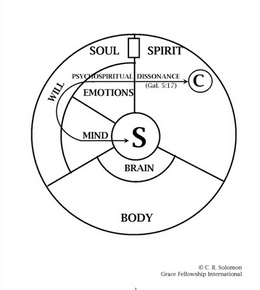
    I have coined this term “psycho-spirtual dissonance” to point up a major issue in discipling believers. The word “psycho” comes from the Greek word for “soul”; “spiritual” refers to God’s Spirit residing in the believer’s new spirit (Rom. 8:16). “Dissonance” is defined as a “lack of agreement; especially: inconsistency between the beliefs one holds or between one’s actions and one’s beliefs.”[1] So pscho-spiritual dissonance is the inner tension between the new life in the believer’s spirit and the independent functioning of one’s mind and will (soul). As a biblical counselor, I am convinced that much of our time is spent on peripheral matters and issues while the core issue often goes begging!

    The thrust of much discipleship involves disciplines, while the function of the flesh may be passed over. While discipling and counseling usually admonishes changes in thinking and behaving, the conflict between the flesh and the Spirit has tended to be overlooked.

    Since the Church has dealt more with the output of the flesh (sins) than its source—the Sin Principle (Romans 7:17), the application of the Cross (Rom. 6:6-14) in preaching and discipleship has been all but missing.

    We need illumination about the nature of the conflict faced by all believers and turn the focus of personal ministry to root causes. The following diagram depicts the conflict in graphic format, with the specifics of dealing with it detailed in Handbook to Happiness (Tyndale) and subsequent books.

    The believer in Jesus Christ inherits a conflict by virtue of his new birth, having received a new nature (“new man” -Col. 3:9, 10). That conflict is defined in Galatians 5:17 as being between the flesh and the Spirit; it is a lifetime battle for supremacy: “For the flesh lusteth against the Spirit, and the Spirit against the flesh: and these are contrary one to the other: so that ye cannot do the things that ye would”. Therefore, such dissonance is a function of the flesh.

    For most Christians, it is a negotiated peace without appropriating the way of victory through faith. When there is a psychological conflict within the soul, the dissonance is heightened and may require outside help, most of which should be rendered by the Church in biblical counseling (which we call clinical discipleship).

    When the Holy Spirit takes up residence in the regenerated spirit of the believer, He intends to take control (Eph. 1:13;4:30). If the believer does not yield control through ignorance or obstinacy, it becomes a battle royal for control. However, yielding control results in a walk in the Spirit: “This I say then, Walk in the Spirit, ye shall not fulfill the lust of the flesh” (Gal. 5:16).

    Unless there is organic impairment in the person, such conflict may be resolved by “losing” the natural life (based on fleshly self in control -Luke 9:24), and being filled with the Spirit (Eph. 5:18). Such surrender and faith exchanges the self-life for the Christ-life (Gal. 2:20). As the Spirit is in the ascendancy, the conflict is eliminated; and major psychological conflict may be resolved without formal psychological intervention. As the “works of the flesh” are replaced by the “fruit of the Spirit” (Gal. 5:22, 23), major life transformation is accomplished by the Holy Spirit.

    With the shallow state of Christianity in our day, it is usual to deal with such dissonance as a purely psychological issue, thus sentencing such a believer to prolonged intervention by therapists and/or the medical profession. When there is an underlying medical condition which is worsened by the “dissonance,” there is usually no observable difference made between the two phenomena: psychiatric and psycho-spiritual. If and when the dissonance is factored out (resolved in Christ), the remainder of the complaint may be properly treated, whether the ailment is psychological or physiological in nature.

    Many of the maladies which are given psychological diagnoses (DSM labels) would be thus be resolved along with the dissonance issue.[2] However, it is usual today that the spiritual aspect of such difficulties is rarely considered.

    Ministries such as Grace Fellowship International (using a Christ-centered approach) witness the Holy Spirit transforming lives routinely. The psycho-spiritual dissonance can be resolved through identification with Christ in death and resurrection (Col. 3:1-4). We know that much of that presently treated in psychotherap—including major psychological issues such as clinical depression—could better be served by dealing with this psych-spiritual dissonance.

    This rationale points to the need for the Church to not only provide soul care, but soul cure—through strategic Christ-centered counsel. In recent decades (with the rise of Christian psychotherapy) referrals are usually made for care without radical cure. But, it also means that the Church must play catch up and emphasize the spiritual maturity process and equip dedicated believers for such discipleship/spiritual formation/counseling. The time is short, and the need is great!

    ______________

    [1] https://www.merriam-webster.com/dictionary/dissonance

    [2] The Diagnostic and Statistical Manual of Mental Disorders (DSM) “is a handbook used by healthcare professionals in the United States and globally to diagnose mental disorders.”

    Fourfold Discipleship: Jesus is Lord

    by John Woodward

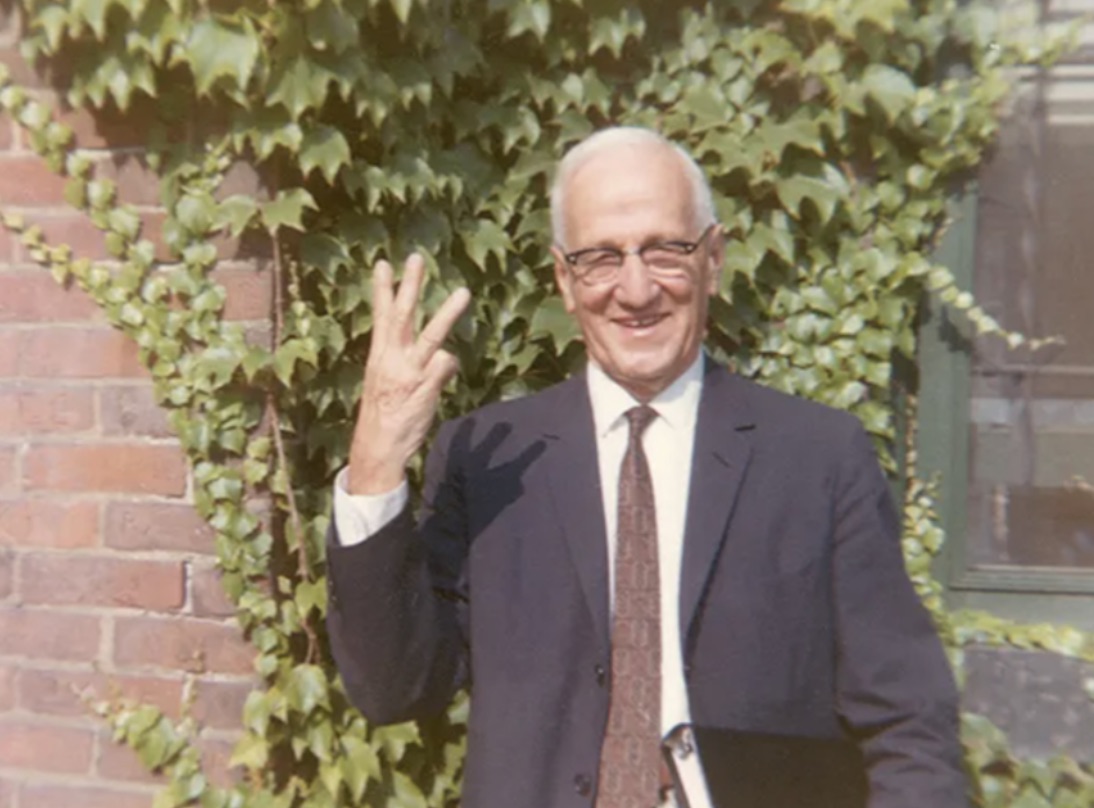
    Perhaps the earliest Christian confession of faith is the statement “Jesus is Lord.” Missionary statesman and author, E. Stanley Jones, used three raised fingers (the peace sign plus ring finger) to represent these three profound words.

    E. Stanley Jones

    This theme is woven throughout the New Testament.

    • “…preaching good news of peace through Jesus Christ (he is Lord of all).” Acts 10:36
    • “If you confess with your mouth that Jesus is Lord and believe in your heart that God raised him from the dead, you will be saved.” Rom. 10:9

    How does the Lordship of Christ relate to the four phases of Discipleship Counseling? [1]

    1. Christ’s lordship initially – redemption

    When a person repents and believes the gospel, they received Jesus Christ as Lord and Savior. There is a recognition of His authority and saving grace. The believer gives this “pledge of allegiance” at salvation. Therefore, if the counselee is not a born again, the goal is for them to bow the knee and become a citizen of God’s kingdom by grace though faith (John 3:3; 1 Cor. 1:9; Eph. 2:8,9; Col. 1:13

    2. Christ’s lordship wholeheartedly – identification

    Although every believer confesses Jesus is Lord, the path of discipleship includes the call to wholehearted surrender. The discipler can use Romans 12:1,2 (along with GFI’s Total Commitment page) to guide a person in this process: “I appeal to you therefore, brothers, by the mercies of God, to present your bodies as a living sacrifice, holy and acceptable to God, which is your spiritual worship. Do not be conformed to this world, but be transformed by the renewal of your mind, that by testing you may discern what is the will of God, what is good and acceptable and perfect” (cf. 1 Pet. 3:15). Notice that this appeal is to those who are already saved – “brethren.” Although appropriating Christ as Life in identification (Gal. 2:20) is more than surrender, it is not less than this. This commitment to fully yield to the Lord is not a promise of perfect submission but a sincere relinquishment of our relationships and rights, enabled by the Holy Spirit.

    3. Christ’s lordship victoriously – liberation

    Jesus Christ “was declared to be the Son of God in power according to the Spirit of holiness by his resurrection from the dead, Jesus Christ our Lord” (Rom. 1:4). His ascension further demonstrated His supreme authority: Jesus Christ “has gone into heaven and is at the right hand of God, with angels, authorities, and powers having been subjected to him” (1 Pet. 3:22). God “disarmed the rulers and authorities and put them to open shame, by triumphing over them in him” (Col. 2:15). Because of Christ’s Lordship—and the believer’s identification with Him—the disciple can submit to God, resist the Devil and demons must flee (James 4:7). “We destroy arguments and every lofty opinion raised against the knowledge of God, and take every thought captive to obey Christ” because He is Lord of all  (1 Cor. 10:5).

    4. Christ’s Lordship daily – devotion

    Even when the disciple yields to God wholeheartedly (Rom. 12:1,2), this needs to be reaffirmed daily. “And he [Jesus] said to all, ‘If anyone would come after me, let him deny himself and take up his cross daily and follow me’” (Luke 9:23). As someone has observed, “the trouble with a living sacrifice is it may crawl off the altar!” As the Lord Jesus persevered in submission to the Father (Phil. 2:5-9) so must we. But this is inspired by the indwelling Holy Spirit and motivated by grace., “for it is God who works in you, both to will and to work for his good pleasure” (Phil 2:13).

    By clarifying these aspects of the discipleship process, several misunderstandings can be avoided:

    • Lordship salvation. This confuses phase 1 and 2, implying that unless a believer is 100% surrendered, his salvation is called into question.
    • Equating surrender with identification. In Discipleship Counseling, sometimes a counselee has fully surrendered and thereby assumes that is all that is called for to experience the abundant life. However, the good news of identification with Christ needs to be discovered and reckoned personally true (Rom. 6:6-11).
    • Teaching grace and identity in Christ without wholehearted surrender. In some cases they have learned about grace and their new identity but have not “sanctified Christ as Lord in their hearts” (1 Pet. 3:15), or continued with yielding their physical members as instruments of righteousness (Rom. 6:12,13). The Life that Christ want to live through us will be a righteous life.
    • Teaching spiritual warfare principles out of context. The believer is not trying to attain victory, but celebrates Christ’s lordship and the revelation of being seated with Him in heavenly places (Col. 3:1-4). In James 4:7 “Submit to God” comes before “resist the Devil.”
    • Neglecting the need for daily surrender. The present tense command to “be filled with the Holy Spirit” (Eph. 5:18) requires yielding to God’s benevolent, gracious control. Otherwise, selfish resistance to God’s will grieves/quenches the Holy Spirit (Eph. 4:30; 1 Thess. 5:19). Our Lord instructs us, “Whoever has my commandments and keeps them, he it is who loves me. And he who loves me will be loved by my Father, and I will love him and manifest myself to him” (John 14:21).

    It was previously mentioned that three raised fingers were used by E. Stanley Jones to signify “Jesus is Lord.” Perhaps four raised fingers could represent the four phases of discipleship counseling: redemption, identification, liberation and devotion. If so, the thumb could symbolize Christ’s Lordship – submission. And your thumb can touch each of your other fingers, illustrating the relevance of Christ’s lordship in each phase of discipleship.

    Let’s continue to joyfully confess “Jesus is Lord” in our personal life and ministry.


    [1] The Four Phases of Discipleship Counseling chart was developed by the author and is used in the Discipleship Counseling training at Grace Fellowship International.

    For more about E. Stanley Jones, see:
    estanleyjonesfoundation.com/

    See this article and The 4 Phases chart with further reading suggestions here:
    gracenotebook.com/fourfold-discipleship-jesus-is-lord/

    Rooted in Christ

    GFI Guide, Rob Semco, has started sharing discipleship insights online. His wife, Nancy, encouraged him to record some of the insights that he has been gleaning from his devotional life and journaling.

    The YouTube channel is titled “Rooted in Christ” based on the imagery of Colossians 2:6,7:
    “As you therefore have received Christ Jesus the Lord, so walk in Him, rooted and built up in Him and established in the faith, as you have been taught, abounding in it with thanksgiving” (NKJV).

    You can view, subscribe and share these videos at
    www.youtube.com/@RootedinChristYT

    Rob has also been posting some articles online. Rob introduces the blog this way:

    “Have you ever wrestled with doubts, feeling like you needed something undeniable to fully trust God? Like the apostle Thomas, I’ve been there—longing to ‘touch His wounds,’ to know beyond a shadow of a doubt that Jesus is real. For years, I struggled with depression and anxiety, living as though faith was out of reach unless I could grasp it tangibly.

    “In His grace, the Lord showed me a truth that transformed my life: through my union with Christ, I no longer had to be bound by despair or fear. Joy and peace were already mine in Him. It was as if Jesus said to me, as He did to Thomas, ‘Put your finger here; see my hands. Stop doubting and believe’ (John 20:27). In that moment, I believed—and my heart responded with awe and surrender: ‘My Lord and my God!’

    “This journal is my response to that grace. Written under the name Believing Thomas, this space reflects who I truly am in Christ—free, whole, and loved—but also who I am becoming as He continues to conform me to His image. Writing anonymously allows me to keep the focus where it belongs: on Jesus. It’s not about my name, accomplishments, or even my struggles. Instead, it’s about pointing you to the One who invites us to know Him, trust Him, and rest in Him….”

    You are welcome to check out this blog: www.rootedinchristjournal.com/

    Let’s pray for God’s blessing on these written and video messages. Rob can be contacted at drselysium@gmail.com

    Ministry Events in Cairo

    March 20-22, 2025

    1. Pastoral Counseling Seminar (English and Arabic) Sessions 1 & 2

    Notes (click on links to access):

    2. Pastors’ meeting

    Notes:

    3. Lifeline Caregivers & GFI Model

    Notes:

    4. Teacher’s session

    Overcoming Trauma: Lessons from the Book of Job (audio)

    Notes

    Photo album

    Music for the Soul and Spirit

    “By day the Lord commands his steadfast love, and at night his song is with me, a prayer to the God of my life.” Psalm 42:8

    One of the channels of grace to encourage both counselor and counselee is edifying music. In addition to a playlist you may be compiling, here are recommended resources.

    1. Music for the Soul is an excellent online and CD music ministry especially intended to minister to troubled hearts. I have been blessed by their albums. The Soul Care Kit
 contains all 164 of their songs, 62 spoken word pieces, 6 discussion guides, 3 documentaries, and 3 books. (Available for a donation of any amount.) Delivered digitally. See also their Healing Music Guide.
This Guide discusses the power of songs in the culture and the brain science that makes them so effective. There is an extensive section on the use of songs in therapy. www.musicforthesoul.org/christian-counselors-therapists/
    2. Be Still Music
      Nona Hovey has comforting piano music albums with contemplative narration. Now her CDs are free online!
      www.BeStillMusic.com
    3. Worship Untangled
      Vernon Terrell is composing and recording songs. He serves as president at Grace Ministries International. His first recorded songs are at www.WorshipUntangled.com

    Here is a sample from my playlist. God bless this means of musical blessing to helper and helpee.

    JBW