Exchanged Life Counselor’s Testimony

Lee LeFebre

[Lee LeFebre has made important contributions to this branch of the Biblical Counseling family tree. Here is a testimony about his spiritual journey. Used with his permission. – JBW]

Daily, I was asking God to be on the throne of my life. I didn’t understand that God would take me through a breaking process, and that Christ didn’t just want to be on the throne of my life, but wanted to be my life.

Throughout college, graduate school, and my work experience in social services, I saw tremendous inconsistencies between psychotherapy and Scripture. The more I analyzed psychotherapy, the less convinced I became that it held any real answers. I believed Christianity had an answer, but what? How could accepting Christ change the shattered lives of the street kids I worked with? I thought they needed Christ and therapy, so I tried to combine Christianity and secular theory for the “best of both worlds.”

I saw a series of contradictions in life. The Bible promised peace that passes all understanding, that keeps our hearts and minds by Christ Jesus; but Christians I knew in the 50’s and 60’s were having nervous breakdowns right and left. The Scripture also promised joy, yet my church was a sponsor of the largest Christian mental health hospital in the country.

I had been in church and Christian schools all my life. At the age of 27, I had received assurance of salvation through the ministry of Campus Crusade for Christ. Yet in spite of all that, I struggled terribly with anxiety, my inability to conquer sin, and my efforts to reconcile psychotherapy and Biblical teaching.

To drive home the truth of my condition and the insufficiency of my efforts, in the early 70’s God showed me five things:

1. God promised peace that passes understanding, and I didn’t have it. I had peace with God, but not the peace of God. I had to confess that I couldn’t attain it. If I were to obtain that kind of peace, it would have to be a gift.

Continue reading…


http://leelefebre.com/

Top Biblical Counseling Books of 2017

Bob Kellemen (Th.M., Ph.D.) compiled this list with its book summaries. He is Professor of Biblical Counseling at Faith Bible Seminary and was the founding Executive Director of the Biblical Counseling Coalition. The list is from the editorial perspective of the Coalition; their theology is primarily Reformed sanctification with a dichotomous view of man, and Nouthetic counseling methodology. Yet, because the authors are Protestant Christians with a conviction of the inspiration, authority, and relevance of the Holy Bible, most of the content is commendable and useful, especially on the resurrection side of the Cross (Gal. 2:20). – JBW


[Reposted from Biblical Counseling Coalition’s blog]

If you are a counselor, pastor, student, one-another minister, small group leader, or spiritual friend, you want to know the most helpful books about biblical counseling—using God’s Word for helping hurting people.

Here, in alphabetical order, are the top 17 books published in 2017 about biblical counseling, written by a biblical counselor about Christian living, or important to biblical counselors.

I’ve selected these books on the basis of their biblical depth, relevance to life, practicality for one-another ministry, faithfulness to the sufficiency of Scripture, application to progressive sanctification, and by surveying what leaders in the biblical counseling world are saying about them.

[Example]

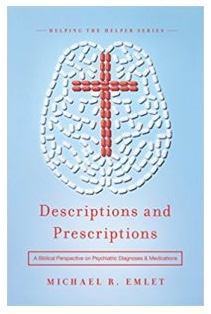
Descriptions and Prescriptions: A Biblical Perspective on Psychiatric Diagnoses and Medication by Mike Emlet, New Growth Press

As Christians, how should we think about psychiatric diagnoses and their associated treatments? We can’t afford to isolate ourselves and simply dismiss these categories as unbiblical. Nor can we afford to accept the entire secular psychiatric diagnostic and treatment enterprise at face value as though Scripture is irrelevant for these complex struggles. Instead, we need a balanced, biblically and scientifically-informed approach. In Descriptions and Prescriptions, biblical counselor and retired physician, Mike Emlet, gives readers a helpful way forward on these important issues as he guides lay and professional helpers through the thicket of mental health diagnoses and treatments. Descriptions and Prescriptions is a clear, thoughtful primer in which the Bible informs our understanding of psychiatric diagnoses and the medications that are often recommended based on those labels.

Continue reading the full article: https://www.biblicalcounselingcoalition.org/2017/12/29/the-17-top-biblical-counseling-books-of-2017/


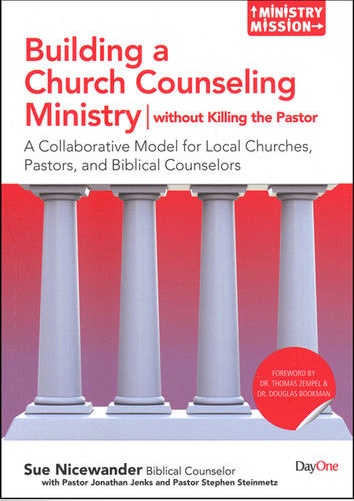
Building a Church Counseling Ministry…

Building a Church Counseling Ministry…without Killing the Pastor was written by Sue Nicewander of Biblical Counseling Ministries in Plover, Wisconsin.

“The concept of this book began with a couple of realizations. First, we have observed that pastors of small to average-sized local churches can use more help with the growing demands of counseling. Second, well-trained biblical counselors are coming out of our Bible colleges and seminaries to a silent job market. How might the two groups be brought together? We started applying the principles of this book with a small group of central Wisconsin Baptist pastors and lay- leaders from ordinary churches ranging in size from roughly 40 to 300 members. The five pastors who started on our advisory board were extremely busy men with multi-faceted ministries that included regular counseling. They all loved the thought of having such resources available, but they also agreed that they had neither the time nor the energy to take on such a project. But when I offered to do the legwork, their ears perked up and we began to discuss the possibilities. The concept that would have overwhelmed a single pastor actually energized the group. Now, ten years later, together we have built a uniquely effective model that supplies counseling resources through a trained biblical counselor for each of their churches as well as consultations, training, and/or referrals for nearly sixty others.”

Sue gives a brief description of Biblical Counseling Ministries at BiblicalCounseling.com.

Although she uses a Nouthetic Counseling approach (ACBC), the administrative aspects of this project are useful for biblical counselors who use other models.

Touching Hearts Ministries

The team from Touching Hearts Ministries in Fayetteville, GA are moving forward in their Exchanged Life Counselor certification process. Three of them plan to attend the Spirituotherapy Workshop November 6-9, and they just purchased the Solomon Online Lectures site license! Now their team (and others who join them in the future) have free access to the 25 online lectures and PDF notes for equipping, group discussion, and ministry application.

We pray for God’s blessing and guidance on their ministry: https://www.touchinghearts.tv/

Spirituotherapy Workshop

The Spirituotherapy Workshop is our favorite event because of the way the Lord ministers to the participants over the four days as we learn, train, and interact. Here’s a comment from a pastor’s wife, answering What was most helpful?

“Christ’s life being IN me which gives me not only a new future, but a new past. Christ’s life is eternal and therefore … I am dead, buried, and raised with Him! Soul and spirit was explained and I understood these as separate parts of me for the first time. I can appropriate Christ’s life in me by faith.” … “I truly enjoyed learning something new every day. The Holy Spirit has been working, and I believe He still is working to continue to clarify and solidify these truths [in my life].”

A video of four of the participant’s testimony is at GFI’s YouTube channel:

The next GFI Workshop in Pigeon Forge, TN is scheduled for November 6-9.

Emotions

a re-post from Dr. James Dobson

As the summer rolls to a close, I want to share a thought with those of you who are struggling with your faith at this time. Some have encountered life-altering physical illnesses. Others have offered prayers that were seemingly unanswered. Still others have suffered financial setbacks and frustrations. As your troubles accumulated, you have wondered if God is really there and if He cares about you and your family. If that has been your experience in recent days, I have some good news for you. It comes from my book, When God Doesn’t Make Sense. You may be a victim of your own confusion about what the Lord is doing in your life. Let me explain.

I wrote another book many years ago entitled, Emotions, Can You Trust Them? It took me 200 pages to say, “No. You can’t believe everything you feel.” Your emotions are suspect at best and often lie to you with a straight face, especially about spiritual matters. Here’s the reason why.

Continue reading: Emotions_Can_You_Trust

.

Here are two other articles on this topic:

Your Palette of Emotions (J. Woodward)

How to Overcome Disagreeable Emotions (Hannah W. Smith)


Suicide: The Temptation to Exit

Living Waters has just produced another culturally relevant movie: Exit: The Appeal of Suicide. “Before you finish reading this, one individual will have ended their life by suicide—because they think they have no other choice. According to the World Health Organization, a massive 800,000 people take their lives every year—one death every 40 seconds. That’s 3,000 a day. For millions who suffer from depression and despair, “EXIT” points to a better way. This compelling movie shines a powerful light in the darkness and offers true hope to those who think they have none. Someone you know may be secretly considering their final exit. Watch “EXIT,” and share it with those you love.” View the trailer here: www.theexitmovie.com

A book that addresses this traumatic topic from an Exchanged Life perspective is Suicide: An Illict Lover. The author identifies the strangle hold of despair and then shows how claiming our co-death and co-resurrection with Christ is an exit that protects life–now and eternally. See ordering information at the GFI online bookstore here.

Empathy Versus Sympathy

(Global Leadership Summit)


Comment: Empathy is an important counseling skill. Whereas sympathy denotes feeling sorry for someone, empathy is to feel with someone.

In non directive counseling, skills–such as using empathy–can become the primary content and model of counseling. However, biblical counseling is different; it is directive. Exchanged Life Counseling has a distinctive message (the Christ-centered life), and methodology.

Yet, in directive counseling empathy is still important. A counselor who is eager to facilitate discovery and progress may forget to empathize. In a therapeutic context, the helper talks with the counselee in a caring way rather than talking at him/her. We are to be quick to listen, and slow to speak…(James 1:19), and we then speak the truth in love” (Eph. 4:15). – JBW