
Living in Christ Ministries

Discipleship Counselors can greatly benefit from the teaching ministry of Bob Hoekstra.

Pastor Bob Hoekstra [1940-2011] was the founder and Director of Living in Christ Ministries. Bob was in ministry since 1967, including pastoring fourteen years in Dallas, TX and eleven years in Irvine, CA… Bob graduated from Dallas Theological Seminary in 1973 with the Master of Theology degree.

Bob’s involvement with the Calvary Chapels began in 1971, when he and his wife Dini visited Calvary Chapel Costa Mesa on a Sunday evening…Upon returning to Dallas, they regularly obtained Pastor Chuck Smith’s teaching tapes and eventually became daily listeners of the Word for Today on the radio.

Bob taught at many church fellowships across the country and overseas (including, Seminars, Pastors’ Conferences, Church Services, Leadership Conferences, Retreats, and Schools of Evangelism/Ministry). He also taught numerous classes at Bible Colleges in California.[1]

Of particular interest to Discipleship Counselors is Bob Hoekstra’s course on Counseling God’s Way. Note how many of the course’s topics correlate with Grace Fellowship’s emphasis:
  1. The Lord as Counselor – Part 1
  2. The Lord as Counselor – Part 2
  3. Counseling and Discipleship
  4. Counseling and Sanctification
    God’s Way in Counseling
  5. God’s Word in Counseling
  6. The Holy Spirit in Counseling
  7. Prayer in Counseling
  8. Church-life in Counseling
    Counselors and Their Equipping
  9. Who is to do Counseling
  10. Equipping for Counseling Ministry
  11. Vital Issues for Counseling – Part 1
  12. Vital Issues for Counseling – Part 2
    Foundational Truths for Counseling
  13. In Adam or in Christ
  14. United with Christ
  15. Walking According to the Flesh
  16. Walking According to the Spirit
  17. Who We are in Christ
  18. Renewing of the Mind
  19. Spiritual Warfare
  20. Victory in Spiritual Warfare
    Major Threats to Counseling God’s Way
  21. Forsaking Our Wonderful Counselor
  22. Turning to Worldly Counsel
    Counseling Session Guidelines
  23. Counseling Session Guidelines – Part 1
  24. Counseling Session Guidelines – Part 2

The course (text and audio) is online here:
www.blueletterbible.org/audio_video/hoekstra_bob/counseling24/counseling-gods-way.cfm The full outline document is here.

Another valuable resource for personal edification and counselee “homework” is his devotional Day by Day by Grace. Each devotional has substantial biblical content with a grace orientation. The full year of devotionals is online as an index, or by creating an account at BlueLetterBible.org, one can subscribe to it as a daily email.
www.blueletterbible.org/devotionals/dbdbg/view.cfm
It is also available in paperback and ebook formats. livinginchrist.org/devotional/

For personal enrichment and reinforcement in the truths of living in Jesus Christ, check out Bob Hoekstra’s many legacy resources at BlueLetterBible.org and LivingInChrist.org.

JBW


[1] livinginchrist.org/about/

Bob’s memorial website is www.bobhoekstra.com/
Psycho-Spiritual Dissonance

By Dr. Charles Solomon

“If we live in the Spirit, let us also walk in the Spirit.”
Galatians 5:25, KJV.

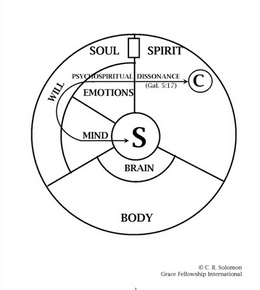
I have coined this term “psycho-spirtual dissonance” to point up a major issue in discipling believers. The word “psycho” comes from the Greek word for “soul”; “spiritual” refers to God’s Spirit residing in the believer’s new spirit (Rom. 8:16). “Dissonance” is defined as a “lack of agreement; especially: inconsistency between the beliefs one holds or between one’s actions and one’s beliefs.”[1] So pscho-spiritual dissonance is the inner tension between the new life in the believer’s spirit and the independent functioning of one’s mind and will (soul). As a biblical counselor, I am convinced that much of our time is spent on peripheral matters and issues while the core issue often goes begging!

The thrust of much discipleship involves disciplines, while the function of the flesh may be passed over. While discipling and counseling usually admonishes changes in thinking and behaving, the conflict between the flesh and the Spirit has tended to be overlooked.

Since the Church has dealt more with the output of the flesh (sins) than its source—the Sin Principle (Romans 7:17), the application of the Cross (Rom. 6:6-14) in preaching and discipleship has been all but missing.

We need illumination about the nature of the conflict faced by all believers and turn the focus of personal ministry to root causes. The following diagram depicts the conflict in graphic format, with the specifics of dealing with it detailed in Handbook to Happiness (Tyndale) and subsequent books.

The believer in Jesus Christ inherits a conflict by virtue of his new birth, having received a new nature (“new man” -Col. 3:9, 10). That conflict is defined in Galatians 5:17 as being between the flesh and the Spirit; it is a lifetime battle for supremacy: “For the flesh lusteth against the Spirit, and the Spirit against the flesh: and these are contrary one to the other: so that ye cannot do the things that ye would”. Therefore, such dissonance is a function of the flesh.

For most Christians, it is a negotiated peace without appropriating the way of victory through faith. When there is a psychological conflict within the soul, the dissonance is heightened and may require outside help, most of which should be rendered by the Church in biblical counseling (which we call clinical discipleship).

When the Holy Spirit takes up residence in the regenerated spirit of the believer, He intends to take control (Eph. 1:13;4:30). If the believer does not yield control through ignorance or obstinacy, it becomes a battle royal for control. However, yielding control results in a walk in the Spirit: “This I say then, Walk in the Spirit, ye shall not fulfill the lust of the flesh” (Gal. 5:16).

Unless there is organic impairment in the person, such conflict may be resolved by “losing” the natural life (based on fleshly self in control -Luke 9:24), and being filled with the Spirit (Eph. 5:18). Such surrender and faith exchanges the self-life for the Christ-life (Gal. 2:20). As the Spirit is in the ascendancy, the conflict is eliminated; and major psychological conflict may be resolved without formal psychological intervention. As the “works of the flesh” are replaced by the “fruit of the Spirit” (Gal. 5:22, 23), major life transformation is accomplished by the Holy Spirit.

With the shallow state of Christianity in our day, it is usual to deal with such dissonance as a purely psychological issue, thus sentencing such a believer to prolonged intervention by therapists and/or the medical profession. When there is an underlying medical condition which is worsened by the “dissonance,” there is usually no observable difference made between the two phenomena: psychiatric and psycho-spiritual. If and when the dissonance is factored out (resolved in Christ), the remainder of the complaint may be properly treated, whether the ailment is psychological or physiological in nature.

Many of the maladies which are given psychological diagnoses (DSM labels) would be thus be resolved along with the dissonance issue.[2] However, it is usual today that the spiritual aspect of such difficulties is rarely considered.

Ministries such as Grace Fellowship International (using a Christ-centered approach) witness the Holy Spirit transforming lives routinely. The psycho-spiritual dissonance can be resolved through identification with Christ in death and resurrection (Col. 3:1-4). We know that much of that presently treated in psychotherap—including major psychological issues such as clinical depression—could better be served by dealing with this psych-spiritual dissonance.

This rationale points to the need for the Church to not only provide soul care, but soul cure—through strategic Christ-centered counsel. In recent decades (with the rise of Christian psychotherapy) referrals are usually made for care without radical cure. But, it also means that the Church must play catch up and emphasize the spiritual maturity process and equip dedicated believers for such discipleship/spiritual formation/counseling. The time is short, and the need is great!

______________

[1] https://www.merriam-webster.com/dictionary/dissonance

[2] The Diagnostic and Statistical Manual of Mental Disorders (DSM) “is a handbook used by healthcare professionals in the United States and globally to diagnose mental disorders.”